Home/Best of/Best Enterprise Employer of Record Providers (2026)
Best Enterprise Employer of Record Providers (2026)
This page is for a large company with hundreds of international employees that needs wide country coverage, a track record at scale, and a provider it can consolidate compliance, payroll and HR administration onto rather than run several vendors in parallel. It settles which Employer of Record providers actually hold up under that kind of volume and geographic spread, not which one is cheapest for a first hire abroad.
How we ranked: Providers covering at least 100 countries, rated at least 4.0 from at least 500 counted customer reviews. Score is 40% share of the 245 countries and territories we track, 30% rating and 30% review volume (log scale). Ratings are smoothed toward the pool average with a prior of 1,000 reviews, so a small review base cannot outrank a large one on a tenth of a point. Ratings are the review-weighted average of G2, Trustpilot and Capterra, the platforms’ own scores, not ours; Glassdoor (employee reviews) is not counted.
EOR Overview lists 144 published providers; 7 made this shortlist because they cover at least 100 countries and hold a rating of at least 4.0 from at least 500 counted reviews. Score weights country share, rating and review volume, with ratings smoothed toward the pool average so a small review base cannot outrank a large one on a tenth of a point. At the top, the gap is about scale of proof as much as country count: Pebl (formerly Velocity Global) leads at 175 countries and 4.9/5 across 5,468 reviews, followed by Deel, Remote, Multiplier, Globalization Partners, Remote People and Oyster, whose figures are compared in full on the table on this page.
Why does an enterprise need an Employer of Record?
A company hiring at hundreds-of-employees scale across many countries needs one compliance and payroll layer it can trust to hold up consistently, not a patchwork of local entities or a vendor that struggles past a certain headcount. An EOR removes the need to set up and maintain foreign entities country by country.
Entity avoidance at scale. Standing up a legal entity in every country an enterprise hires into is slow and costly; an EOR lets the company add headcount in a new country without that step, repeated across dozens of markets.
Consistent compliance across a wide footprint. Local labor law, tax and statutory benefit rules vary by country, and an enterprise carrying risk across many jurisdictions needs one contract and one process rather than dozens of local counsel relationships.
Consolidation for HR and finance. Running payroll, benefits and contracts through a single provider simplifies reporting and reduces the number of systems finance and HR must reconcile across regions.
Integration with existing HR stack. Enterprises typically run an HRIS, payroll system or ATS already; providers on this list report integration counts from 5 to 54, which matters for how much manual data reconciliation a large HR team will carry.
Room to convert contractors to employees. Enterprises often start relationships as contractors before converting to formal employment; several providers on this list publish separate contractor terms alongside EOR employment, which matters when headcount plans shift.
What should an enterprise check before choosing an EOR provider?
Country count and star rating are a starting filter, not the decision. An enterprise buyer should check depth of coverage in the specific countries it hires in, how a provider's terms scale across hundreds of employees, and how much proof sits behind the rating before signing.
Coverage in the countries that matter, not just the total. A provider listing 188 countries and one listing 116 both appear on this shortlist; what matters is whether the specific countries the company hires in are covered well, not the raw total.
Review volume behind the rating. A 4.8 or 4.9 rating built on a few thousand reviews carries more weight than the same score on a few hundred; check the review count alongside the star rating, not the star rating alone.
Integration count against the existing HR stack. Verified integrations on this list range from 5 to 54; a company running a specific HRIS or payroll system should confirm the provider connects to it before assuming a smooth data flow.
Contractor-to-employee conversion terms. Several providers on this list publish separate contractor offerings alongside EOR employment; check how conversion from contractor to EOR employee is priced and handled operationally, since enterprise workforces often shift between the two.
Exit and transition terms. Moving hundreds of employees off a provider, whether to a new EOR or to owned entities, should be checked before signing; this varies by provider and is rarely covered in headline terms.
Free & independent
Not sure which EOR fits?
Tell us your team size, budget and where else you're hiring, we'll shortlist the best-matched providers. No cost, no sales pitch.
Key metrics side by side. Blank cells are pending verified data.
Metric
Pebl (formerly Velocity Global)Our #1
Deel
Remote
Multiplier
Globalization Partners
Remote People
Oyster
EOR / month
$399
$599
$699
$459 (Core · billed annually)
$599
$199
$699
Contractor / mo
–
$49
$29
$40 (billed annually)
$39
$29
$29
Country coverage
175
153
186
171
188
149
116
G2 rating
4.6/5
4.7/5
4.5/5
4.7/5
4.4/5
4.7/5
4.4/5
Capterra
4.9/5
4.9/5
4.3/5
4.4/5
4.5/5
4.9/5
4.6/5
Trustpilot
3.2/5
4.6/5
4.6/5
4.8/5
4.3/5
3.9/5
3.8/5
Overview of the best EOR companies
A closer look at each provider: what makes it distinct, who it suits, and what it costs.
#1
Pebl (formerly Velocity Global)
Our top pick · 175 countries, 4.9/5 across 5,468 reviews
Our verdict
Pebl (formerly Velocity Global) covers 175 countries and draws strong compliance ratings on G2, making it a credible choice for companies that prioritize legal certainty over cost. Pricing is available on custom quote only, and some workflows still require human involvement, which may not suit teams expecting full automation.
Best for: Mid-to-large teams hiring across multiple regions who need localized compliance support and broad HRIS integrations rather than the lowest possible per-seat cost.
Pros & cons
Pros
Rated #1 for compliance on G2 with more employment licenses than most competitors and local legal teams in 185+ countries
AI-powered Alfie assistant provides instant compliance guidance in 50+ languages, significantly reducing response times for routine questions
Transparent pricing at $399 per employee per month with no hidden fees or surprise charges
24/7 dedicated account manager support with locally based teams across time zones
Extensive platform integrations with major HRIS and ATS systems including ADP, Oracle, Greenhouse, and BambooHR
Cons
Higher pricing at $399 per employee per month compared to budget providers like Remofirst at $199
Limited volume discounts available, meaning costs scale linearly as headcount grows
Some workflows require human involvement rather than full self-service, which may slow down tech-forward teams preferring automation
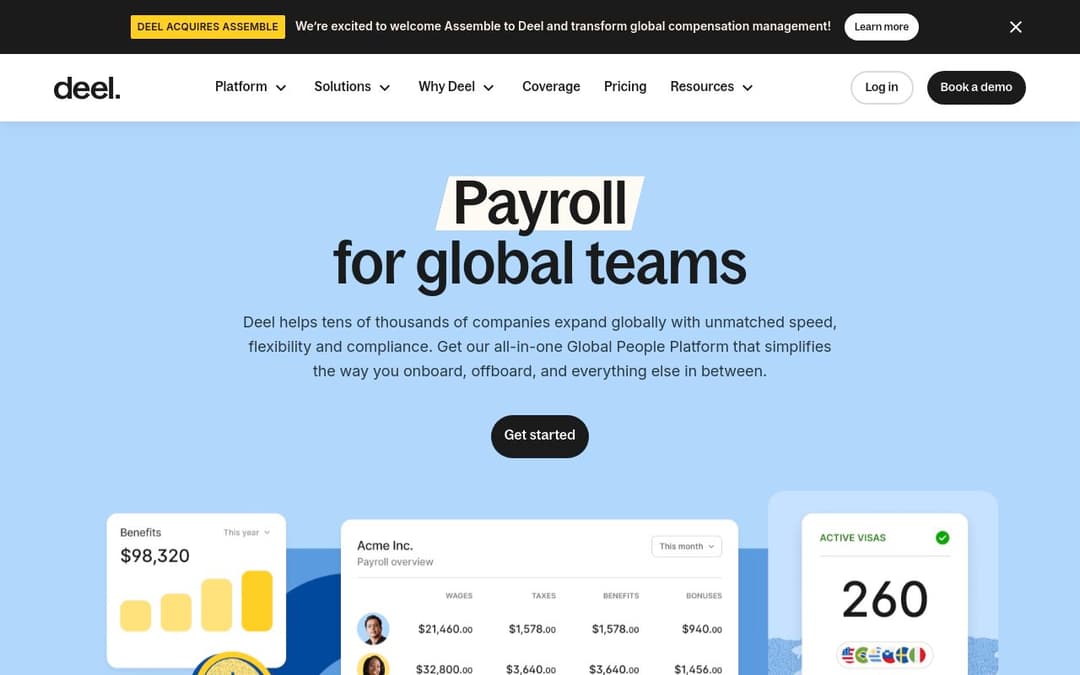
Deel covers 153 countries with EOR services starting from $599 per month, making it one of the broader options available for companies hiring across multiple regions simultaneously. The platform consolidates employment contracts, payroll, benefits, and tax filing into one interface, which reduces the operational overhead of managing separate tools. The trade-off is pricing that sits at a premium compared to some competitors, and benefits customization beyond standard packages is limited.
Best for: Companies scaling international teams across multiple continents who need a single platform to handle compliant hiring, payroll in multiple currencies, and locally relevant benefits without assembling point solutions.
Pros & cons
Pros
Wide Geographic Coverage: Established presence in over 150 countries, offering truly global hiring capabilities.
User-Friendly Platform: Intuitive interface that simplifies complex international hiring processes.
Quick Setup: Businesses can hire international employees within days rather than weeks or months.
Extensive Benefits Options: Offers competitive, locally-relevant benefits packages in each country.
Strong Compliance Track Record: Regular updates to maintain compliance with changing local regulations.
Remote covers 186 countries and operates through directly owned local entities, which gives it a strong compliance footing but also drives pricing that starts from $699 per month for EOR services. The owned-entity model, combined with tools like Remote IP Guard and stock options management, makes it a serious option for companies that need more than basic payroll. Smaller teams or those with straightforward needs may find the feature depth more than they require.
Best for: Growth-stage or mid-market companies hiring internationally across multiple countries that need built-in IP protection, equity management, and benefits administration under one platform.
Pros & cons
Pros
Direct ownership of local entities ensures better control and compliance
Strong intellectual property protection through Remote IP Guard
Complete suite of HR tools including recruitment and relocation
Dedicated stock options management capabilities
Extensive contractor management coverage
Strong benefits administration system
Cons
Full-time (EOR) employment coverage is more limited than its broader contractor and payroll reach
Multiplier offers competitive entry pricing from $459 per month for EOR services and covers 170 countries, making it a practical option for startups and SMEs expanding internationally on a budget. Third-party reviewers rate it highly across multiple platforms, though new users may face a learning curve with the platform interface and email support response times can be inconsistent.
Best for: Startups and small-to-mid-sized businesses that need fast international onboarding, equity management support, and predictable pricing without committing to a large enterprise contract.
★ 4.8 across 4,410 reviews · $459 (Core · billed annually) / employee / mo
Globalization Partners is a well-established provider covering 188 countries, with entity ownership in most of its markets and a technology platform that connects with major HR tools. Pricing is available only on request, and the premium cost structure tends to place it out of reach for smaller or budget-conscious teams. The combination of financial stability, analyst recognition, and direct entity control makes it a credible choice for mid-to-large enterprises prioritizing compliance and scale.
Best for: Mid-size to enterprise companies that need broad international coverage across 188 countries and want direct entity ownership backing their employment relationships.
Remote People covers 150 countries with EOR services starting from $199 per month and contractor management from $29 per month, making it a credible option for companies hiring across multiple regions. The 24-48 hour onboarding and transparent pricing are genuine strengths, though the $199 entry point is higher than some competing platforms and customer service availability has gaps depending on time zone.
Best for: Teams that need fast international onboarding, built-in recruitment support, and direct access to legal compliance experts across a broad range of countries.
Oyster covers 116 countries with transparent, published pricing starting from $699 per employee per month, making it a straightforward option for companies that want predictable costs and fast onboarding. The platform's automation and built-in compliance tools reduce administrative overhead, though that starting price may be a barrier for smaller organizations hiring only one or two people internationally.
Best for: Growth-stage companies and mid-sized teams that need to hire across multiple markets quickly, with a preference for transparent pricing and a mission-aligned vendor.
Among providers meeting the enterprise bar (100+ countries, 4.0+ rating, 500+ reviews), Pebl (formerly Velocity Global) ranks first on EOR Overview's scoring, with 175 countries and 4.9/5 across 5,468 reviews. Deel follows with the largest review base on the list at 20,427. The right fit depends on which countries the company hires in and its existing HR stack; the full comparison is in the table on this page.
How is this enterprise EOR shortlist ranked?
The rule requires at least 100 countries covered and a rating of at least 4.0 from at least 500 counted reviews. The score weights country share (40%), rating (30%) and review volume on a log scale (30%). Ratings are smoothed toward the pool average with a prior of 1,000 reviews so a small review base cannot outrank a large one narrowly.
How many countries does an enterprise EOR need to cover?
This shortlist ranges from 116 to 188 countries covered, all above the 100-country threshold set for enterprise use. The right number depends on where the company actually hires, not the provider's total; a provider covering fewer countries overall can still be the better fit if it covers the specific markets in question well.
Can employees be converted from contractor to EOR employee status at enterprise scale?
Several providers on this shortlist offer separate contractor terms alongside EOR employment, which supports converting a contractor relationship into formal employment as headcount plans change. The specific process for conversion varies by provider and should be confirmed directly rather than assumed.
How many integrations do enterprise EOR providers support?
Verified integrations among shortlisted providers range from 5 to 54, covering connections to HR information systems, payroll and related tools. A company running an existing HRIS or payroll platform should confirm the provider connects to it directly, since integration depth varies widely across this list.
Is a higher country count always the right choice for an enterprise?
Not necessarily. Globalization Partners covers the most ground on this shortlist at 188 countries but sits at 4.4/5 from 1,268 reviews, a smaller proof base than the leaders. Coverage breadth matters, but it should be weighed against rating, review volume and whether the provider's strongest markets match the company's actual hiring footprint.
More EOR shortlists
The same directory data, ranked for other regions and situations.
We compare published provider information and customer feedback to help you weigh your options. Source links and dates let you check the information behind our reviews.
Data collection
Official company documentation and regulatory filings, direct verification with company representatives, trusted third-party databases (Crunchbase, LinkedIn), and public financial reports and press releases.
Verification
We check pricing and coverage against source material. Details can change, so ask for a quote for your hiring country. Our reviews are based on research; we identify hands-on testing separately where it applies.
Ratings
The scores shown are averages of verified third-party platform ratings (G2, Trustpilot, Capterra), always attributed. We do not publish our own star rating.
Independence
Referral-funded: we may earn a fee if you sign up through our links, at no cost to you. It never affects rankings, verdicts, or the data on this page.
Robbin is the co-founder of EOR Overview, an independent research site for Employer of Record services. He has been in the international hiring space for over a decade.